
CliftonStrengths Leadership Domains - A Practical Guide
Every single CliftonStrengths (formerly Gallup StrengthsFinder) talent theme has its unique power and area of contribution. The idea of the CliftonStrengths Leadership domains is to show where specifically each of the CliftonStrengths talent themes can shine at its brightest. For example, the Achiever talent theme shines brightest in the activities and tasks that are executing in nature. Whenever I run different CliftonStrengths Leadership or Team Building workshops, both in Singapore or around Asia, I will take time to help people understand how each of the CliftonStrengths talent theme stands out powerfully in a certain domain. I will also take time to explain how this idea of Leadership domain can be easily misinterpreted without understanding the context.
Why the Leadership Domains Matter for Your Team
Every team in an organization require all four domains to be effective and high performing. All four domains can be mapped to specific tasks that each team delivers. There are a few reasons why the leadership domains matter for each team.
At the core, the four leadership domains predicts the primary source of motivation for each team member. With that frame, the domains also predict the strongest contribution of a particular individual to the team.
When a team is unaware of their domain distribution, the deployment of manpower for the specific tasks might not be strengths-based. This risk frustration faced by the team member assigned the tasks and the quality of results.
When a team is unaware of their domain distribution, they often misread each other. The person with strong Executing themes gets frustrated when the Strategic Thinking person keeps generating ideas without following through. The Relationship Building person feels steamrolled when the Influencing person drives hard toward a decision without checking in. The Influencing person mistakes the Executing person's quiet focus for disengagement.
Understanding the four domains does not just tell you what each person is good at. It tells you why people approach work the way they do and gives your team a shared language to navigate those differences without it becoming personal.
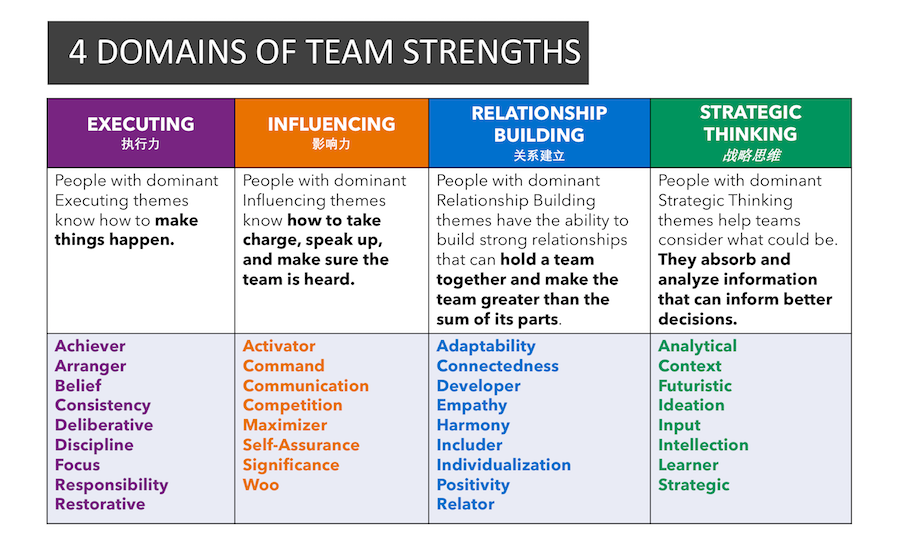
What Each Domain Looks Like in Practice
Executing - The engine of the team. People dominant in Executing themes are the ones who turn conversations into action. They keep score, follow through, and feel most alive when things are moving. In a team context, they are often the ones asking "when does this happen?" and "who is responsible?" If your team lacks Executing energy, great ideas rarely become completed projects.
Influencing - The voice of the team. People dominant in Influencing themes know how to sell an idea, energise a room, and move people toward a direction. They are naturally comfortable taking charge and speaking up. In a team context, they expand the team's reach and make sure the team's work gets noticed. If your team lacks Influencing energy, good work can go unseen and the team can struggle to gain buy-in from stakeholders.
Relationship Building - The glue of the team. People dominant in Relationship Building themes hold the team together through trust, care, and connection. They notice when someone is struggling, invest in relationships beyond the task, and create the psychological safety that allows others to contribute fully. If your team lacks Relationship Building energy, performance may be high in the short term but team cohesion and trust erode over time.
Strategic Thinking - The mind of the team. People dominant in Strategic Thinking themes absorb information, ask probing questions, and help the team see possibilities and implications others miss. They are most energised when thinking ahead, analysing options, and challenging assumptions. If your team lacks Strategic Thinking energy, the team may execute efficiently but keeps doing the same thing and lose out on innovations in the long run.
READ MY #1 ARTICLE ON THIS WEBSITE
8 Things You Need to Know about CliftonStrengths Leadership Domains.
A Note on Domain Dominance and Team Balance
Since 2014, I started doing CliftonStrengths coaching and facilitating CliftonStrengths workshops across Singapore and Asia. One of the most common discoveries teams make is that they are heavily weighted in two (RB and Executing) or three domains (RB, Executing and ST). Most are lacking in the Influencing domain and some teams are almost entirely absent.
This is not a problem to fix. It is information to act on.
A team light in Influencing energy will often do excellent work that goes unnoticed. They execute well, think clearly, and care deeply for one another but struggle to sell their ideas upward, gain stakeholder buy-in, or make their presence felt beyond their immediate circle. In Singapore's corporate and organisational culture, where visibility and advocacy matter enormously for a team's resourcing and recognition, this can quietly hold a high-performing team back.
The goal is not to suddenly recruit for Influencing. The goal is for the team to become aware of their collective profile so they can compensate deliberately, partner intentionally, and stop misreading each other. What looks like a quiet team may simply be a team with deep Relationship Building and Executing energy doing exactly what those domains do best. What feels like a lack of drive may actually be an absence of Influencing voices to champion what the team has already built.
Domain awareness does not change who people are. It changes how clearly they can see each other.
Frequently Asked Questions
Are the best leaders those who have all four domains spread across their dominant talents? What if I do not have strengths across multiple domains as a leader?
This is likely untrue. Most leaders I coach have dominant themes concentrated in one or two domains and some are spread across all four. There are no common patterns. Gallup's research is also clear: there is no ideal domain spread for leadership effectiveness. What matters is not how many domains you cover, but how well you understand the domain or domains where your themes are strongest, and how deliberately you leverage that understanding. A leader who knows they are deeply Executing in nature and builds a team with strong Influencing and Relationship Building energy around them will consistently outperform a leader with themes spread across all four domains who has never stopped to understand what any of them actually mean for how they lead.
I only have two domains among my dominant talents. What should I do?
The first thing to do is resist the urge to see this as a limitation. The weakness mindset is deeply embedded especially in Singapore and Asia culture. Having two dominant domains means you have a clear, concentrated area of natural contribution. This clarity is actually a gift. The real work is twofold. First, go deep on understanding what those two domains genuinely look like when they are operating at their best in your specific role and context. Second, become intentional about the domains you are not naturally drawn to. This does not mean faking it or forcing yourself to develop themes you do not have. It means being honest about where your blind spots are, seeking out complementary partners whose domains balance yours, and structuring your team and your working relationships in ways that compensate deliberately. In my coaching and workshop work, I help leaders move from "I only have two domains" to "I lead strongly with two domains and here is exactly how I am going to use them". This is a powerful shift towards strategic and leadership effectiveness.
What if my team is missing an entire domain?
This is more common than most teams realise. As I shared earlier, the Influencing domain is the most frequently absent one in the teams I work with across Singapore and Asia and teams often do not know this is the source of their frustration until we map it out together in a workshop. A team missing an entire domain is not a broken team. It is a team with a specific and identifiable blind spot that needs to be named and addressed. Once the gap is visible, we can work on it concretely, identifying who in the team may have latent themes in the missing domain further down their profile, adjusting how meetings and decisions are structured to compensate, or being intentional about which external partnerships or stakeholder relationships can provide what the team cannot generate internally. What I find most consistently is that naming the gap changes the team's relationship with it. It stops being a source of shame or confusion and becomes something the team can work with together.
How do the Leadership Domains connect to CliftonStrengths team building workshops?
The four domains are one of the most consistently powerful frameworks I use in CliftonStrengths team building workshops, both in Singapore and across Asia. When a team can see their collective domain profile mapped out together, something shifts in the room. Tensions that felt personal suddenly make sense. The person who always pushes for action and the person who always wants more time to think are not in conflict - they are operating from different domains. The team member who keeps asking "what are the common ground we have already established?" is not slowing things down. This person is bringing Relationship Building energy that the team genuinely needs so that conflicts do not drive the team apart. The domain map gives teams a shared language for their differences that is non-threatening, accurate, and immediately actionable. In my half-day and full-day workshop formats, the Leadership Domains conversation sometimes lands as one of the most memorable parts of the session because it helps people understand not just themselves, but each other, in a way that sticks long after the workshop ends.
Work With Singapore's Pioneer CliftonStrengths Coach
I have been facilitating CliftonStrengths workshops in Singapore since 2014.
And I’m proud and thankful to be the world's only coach to hold both the Gallup Gold and Platinum Certified CliftonStrengths Coach awards, distinctions Gallup has since retired. Over twenty years of people development work and hundreds of CliftonStrengths workshops across Singapore and Asia, the Leadership Domains conversation has been one of the most consistently transformative parts of every session I facilitate - for leaders, teams, and organisations alike.
If you are a leader wanting to understand your own domain profile more deeply, or an organisation looking to run a half-day or full-day CliftonStrengths team building workshop, I would love to have a conversation.